
Saturday, July 28, 2012
Hashed Potato Pancakes

Silverside or corn beef is one of the most versatile meats. Not only does it make a very satisfying meal, but the leftovers can be put to several different uses; a sandwich of corn beef and piccalilli makes a great lunch and of course there are the well known hash brown cakes.
It was along the lines of hash brown cakes that my thoughts wandered, but wanted something with a bit more crunch that also just might accommodate my desire for a little maple syrup. Okay, not diet friendly but completely delicious!

Potato pancakes seemed the ideal way to carry this off, because really, how can you go wrong with fried potato? It was just a matter of adding some finely shredded slices of corn beef and drizzling over the maple syrup. Of course sour cream would be nice instead of maple syrup or both could come along for the ride.
Hashed Potato Pancakes
2 eggs
2 heaped tablespoons plain flour
100ml milk
nutmeg, a good pinch
salt & fresh ground pepper
2 or 3 floury potatoes, grated
6 to 8 thin slices of corn beef, shredded with a knife
oil for frying
maple syrup - optional
sour cream - optional
In a bowl, lightly beat the eggs, add the flour and milk then beat until smooth. Season with the nutmeg, salt and quite a lot of freshly ground pepper. Wrap the grated potato with a tea towel and squeeze out as much moisture as you can and add to the batter along with the shredded corn beef. Check the seasoning again.
Place a film of oil in a frying pan and when hot, add in spoonfuls of the mixture and flatten with a spatula or egg slice. Fry until well browned, turn and brown the other side, keep warm until all the mixture is used up.
Place on plates and top with sour cream, maple syrup or any other desired topping.



Sunday, July 22, 2012
Easy Tomato Soup

With summer long gone, the taste of tomatoes has gone to pot, so to speak. Winter tomatoes are watery and tasteless, with the texture of cardboard. But, if you've been clever enough to preserve the bounty of your seasonal home garden, that sweet rich taste is at your fingertips.
No need to despair if you haven't got your own preserves though, good quality tinned tomatoes are always available, but it must be said, when it comes down to it, the Italians have tinned tomatoes down pat.
Aside from all the obvious pasta sauces one can make from them, a quick, dead simple way to have the taste of summer in the colder months is to make tomato soup with all the ingredients straight from the pantry. There's not a lot of effort involved but it's loaded with flavour and is happy enough to be made with any decent store bought stock, though homemade is always hard to beat.
Easy Tomato Soup
(serves 4)4 tablespoons olive oil
1 onion, roughly chopped
2 cloves garlic, roughly chopped
pinch of chilli flakes - optional
1 litre chicken stock
800g tinned tomatoes - whole plum tomatoes are best
salt & fresh ground pepper
In a large pot, add the olive oil, chopped onion and garlic then gently fry, stirring occasionally just until the onion starts to turn golden, add the chilli flakes if using and fry for a minute more. Add the chicken stock and tomatoes and bring to the boil, then reduce the heat and simmer for 10 minutes. Liquidize the soup with a stick blender or in a blender until smooth. Season with salt and fresh ground pepper to taste. Reheat and serve piping hot.
Thursday, September 01, 2011
A Matter of Opinion
Has someone moved the silly season?
It seems the only explanation after a cursory reading of the list that is purported to be the top 100 restaurants in Australia as published by Gourmet Traveller.
Publishing such a list is always going to be controversial, every restaurateur worth their salt wants to be aboard and some worthy contenders inevitably miss out. Not to mention ongoing interstate rivalries, which seem to dog this particular restaurant award year after year and have now drawn the attention of two leading food critics.
In Epicure, their chief reviewer, Larissa Dubecki wrote "...Last week's Gourmet Traveller honours caused their annual consternation with the Sydney-centric nature of the rankings...According to the magazine, Sydney has seven of the top 10 restaurants in the nation..."
But there's more, scan down the next 10 spots and another seven of them are also occupied by Sydney restaurants. That's a whopping 70% of the nation's top twenty restaurants located in the Harbour City. To be clear, that's the top twenty for ALL of Australia.
However, there was one listing that ought to be causing red faces amongst the organisers, Melbourne's Attica.
The Age Good Food Guide have just crowned Attica the best restaurant in Victoria and a few months prior, the respected S.Pellegrino world's best restaurant list named them as the 53rd best in the world, with only one other Australian restaurant above them. Gourmet Traveller felt very differently though, placing them not even amongst the country's top ten, but a paltry 12th on their list, in what can only be described as a mark down by comparision.
As John Lethlean, the restaurant reviewer for The Australian, tweeted in the social media, "Pleasing to see Attica getting recognition Gourmet guide didn't find warranted".
How is it possible to be so out of kilter with not one, but two respected publications? How do Gourmet Traveller justify their positioning?
I asked Lethlean for his thoughts on the matter and this is what he had to say.
"The trouble with guide books is that they rely to an unhealthy level on contributors. As someone who gets about the country, eating in restaurants, more than most, I can definitely say that some of Gourmet's contributors are way off the mark, which is in no way to diminish the effort Pat Nourse puts into the Gourmet Guide. These things are huge work. But when someone in Perth, for example, tells Pat a place like Kitsch should be in the guide, the vulnerability of the editor is exposed. I should know, I've been in that position."
To have credibility, lists like these need to appear impartial. Yet, it almost seems like Gourmet Traveller and a few Sydney restaurants are just one chesterfield short of being some sort of cosy little club.
Having a national list is a worthwhile endeavour, but perhaps it's time for a rethink on how it's compiled with a greater consideration for transparency.
It seems the only explanation after a cursory reading of the list that is purported to be the top 100 restaurants in Australia as published by Gourmet Traveller.
Publishing such a list is always going to be controversial, every restaurateur worth their salt wants to be aboard and some worthy contenders inevitably miss out. Not to mention ongoing interstate rivalries, which seem to dog this particular restaurant award year after year and have now drawn the attention of two leading food critics.
In Epicure, their chief reviewer, Larissa Dubecki wrote "...Last week's Gourmet Traveller honours caused their annual consternation with the Sydney-centric nature of the rankings...According to the magazine, Sydney has seven of the top 10 restaurants in the nation..."
But there's more, scan down the next 10 spots and another seven of them are also occupied by Sydney restaurants. That's a whopping 70% of the nation's top twenty restaurants located in the Harbour City. To be clear, that's the top twenty for ALL of Australia.
However, there was one listing that ought to be causing red faces amongst the organisers, Melbourne's Attica.
The Age Good Food Guide have just crowned Attica the best restaurant in Victoria and a few months prior, the respected S.Pellegrino world's best restaurant list named them as the 53rd best in the world, with only one other Australian restaurant above them. Gourmet Traveller felt very differently though, placing them not even amongst the country's top ten, but a paltry 12th on their list, in what can only be described as a mark down by comparision.
As John Lethlean, the restaurant reviewer for The Australian, tweeted in the social media, "Pleasing to see Attica getting recognition Gourmet guide didn't find warranted".
How is it possible to be so out of kilter with not one, but two respected publications? How do Gourmet Traveller justify their positioning?
I asked Lethlean for his thoughts on the matter and this is what he had to say.
"The trouble with guide books is that they rely to an unhealthy level on contributors. As someone who gets about the country, eating in restaurants, more than most, I can definitely say that some of Gourmet's contributors are way off the mark, which is in no way to diminish the effort Pat Nourse puts into the Gourmet Guide. These things are huge work. But when someone in Perth, for example, tells Pat a place like Kitsch should be in the guide, the vulnerability of the editor is exposed. I should know, I've been in that position."
To have credibility, lists like these need to appear impartial. Yet, it almost seems like Gourmet Traveller and a few Sydney restaurants are just one chesterfield short of being some sort of cosy little club.
Having a national list is a worthwhile endeavour, but perhaps it's time for a rethink on how it's compiled with a greater consideration for transparency.
Saturday, August 20, 2011
Ruby Blood Navel Oranges

Checking out the fruit section in the local greengrocer, a new type of orange caught my eye. Marked as a ruby blood navel, the skin had a hint of the blood orange's blush and intrigued, bought some to try.
Recent years has seen an increase in new varieties of apples, such as pink ladies and fuji, however, there doesn't seem much new in the way of citrus fruit, so it was exciting to see something a bit different from the same old navel and valencia oranges.

Cutting the fruit reveals a gorgeous soft ruby coloured flesh, sort of halfway between the blood and navel orange. The taste was the real revelation, amazingly sweet and not overly acid.
I needed to know more about this superb orange.
Now you'd think in the middle of an orange glut after many years of drought, orange producers would be happy to inform the public about their products, especially at this time, which has been declared orange week by Citrus Australia, whereby we are all being encouraged to eat more oranges to help our growers get back on their feet.
It would be kind of nice if the producers would reply to email enquiries, but I was very grateful to Sarah Robins for supplying me with information.
Now the name ruby blood navel doesn't exactly trip off the tongue, but it seems to be one and the same as a Cara Cara, an orange first discovered at the Hacienda de Cara Cara in Venezuela in 1976 and Australia now produces 2000-3000 tonnes annually.
The supplied tasting notes suggest,'...subtle undertones of cherry and delicate hints of rose and blackberries.'
According to a recent Citrus Australia interview, we cannot compete with the cheaper Brazilian concentrate that supplies most of the orange juice in the supermarkets. What they'd like us to do is eat more oranges or make our very own superior fresh juice.

Well, you all know me well enough to realize that there's a little extra something going into my juice, they did say to drink! I like a good vodka and orange, but made with ruby blood navels, it was the nicest Screwdriver I've ever had.
If you'd like to try them, you'll need to hurry as the season goes from mid-to-late June through to mid-to-late August.
Go on, they're sensational.
Saturday, July 02, 2011
Chicken Cacciatora

It was the supermarket pack of on-the-bone free range chicken pieces, drumsticks, thighs and wings, that got me thinking about a long slow braise, something with a tomato's cheery red to colour a dim winter's day.
Cacciatora means hunter style, which in turn means this dish is extremely adaptable, just like all good hunters. Not being in the mood for mushrooms meant that they were dispensed with, but I did like Jamie Oliver's suggestion of green olives, sadly which, weren't to hand. Being no frills though, meant it was very child friendly.
Your choice of red or white wine shows favour to either the south or north of Italy. No oregano? How about some marjoram instead. Some capsicum or other vegetable won't upset things, just pop them in.
Perhaps the one thing that does offer an advantage is to use the best quality chicken you can afford. Not only is the texture and flavour notably superior, they tend to be less fatty, meaning a less oily result.
Rice is an easy side, but served on wet polenta, it would positively make a cold winter's night shine.

Chicken Cacciatora
(serves 6)
1.5kg chicken pieces, thighs, drumsticks and wings
salt & fresh ground pepper
plain flour
olive oil
2 onions, finely diced
4-6 cloves garlic, finely diced
250ml white wine
2 400g tins plum tomatoes, pulped
1 teaspoon dried oregano or marjoram
1 sprig rosemary
8 dried bay leaves
chopped parsley
If using chicken wings, trim off the wing tip, season each chicken piece with salt and fresh ground pepper, then dredge in the plain flour.
In a large casserole dish, big enough to hold all the chicken, heat some olive oil and brown all the chicken pieces a few at a time and remove to a plate. In the same oil, gently sweat the onion and garlic until just turning brown, stirring often.
Turn up the heat, add the wine and boil until reduced by half, then add the plum tomatoes, dried oregano or marjoram, the sprig of rosemary and the bay leaves. Season with salt and fresh ground pepper. Bring to a boil, then slide in all the chicken pieces and any juices that have collected.
Pop into an oven set to 160c for 1.5 hours. When cooked, take out of the oven and skim off as much oil as possible. If the sauce is too thin, remove the chicken and boil until reduced to your liking. Serve with rice or wet polenta, sprinkled with some chopped parsley
Monday, June 06, 2011
Goulash Soup

One of our firm winter favourites would have to be goulash soup. Not only very filling but extremely tasty to boot. It's also one of the few soups where we are happy to use just water as the liquid, just as the herdsmen on the Great Plain of Hungary did for centuries.
No doubt, a well made stock wouldn't be wasted, adding another layer of flavour and some body, but hey, sometimes it's a bonus knowing there isn't any extra cooking.
We've tried a few different meats, but have settled on oyster blade as it has a good amount of gelatinous connective tissue plus a bucket load of deep beef flavour and doesn't take too long to cook.
Gulyásleves
(Goulash Soup)
1kg oyster blade steak
3 tablespoons lard or oil
2 onions, diced
1 tablespoon paprika
1 teaspoon salt
1 teaspoon caraway seeds
2 tablespoons tomato paste
4 medium waxy potatoes, chopped
8 cups water
1 or 2 beef stock cubes (optional)
1 green pepper, seeded and sliced into strips
csipetke
Cut meat into cubes. In a large casserole or pot, heat lard or oil and saute onions until transparent. Add beef, paprika, salt and caraway seeds and continue to saute for 10 minutes, stirring. Add tomato paste and water, simmer for 30 minutes and add potatoes, cook for 15 minutes. Add pepper strips and csipetke and cook for 10 minutes more and serve.
Csipetke
1/2 cup of plain (all purpose) flour
pinch of salt
1 egg
1 teaspoon water (optional)
In a bowl combine flour, salt and egg. Knead until a stiff dough is formed, adding water if necessary. Flatten the dough with the palm of your hands until 1 cm (1/2") thick. Pinch off 1 cm (1/2") pieces of dough, squeeze them flat with your fingers and drop into the simmering soup.
Saturday, June 04, 2011
Fennel, Guanciale & Fontina Quiche
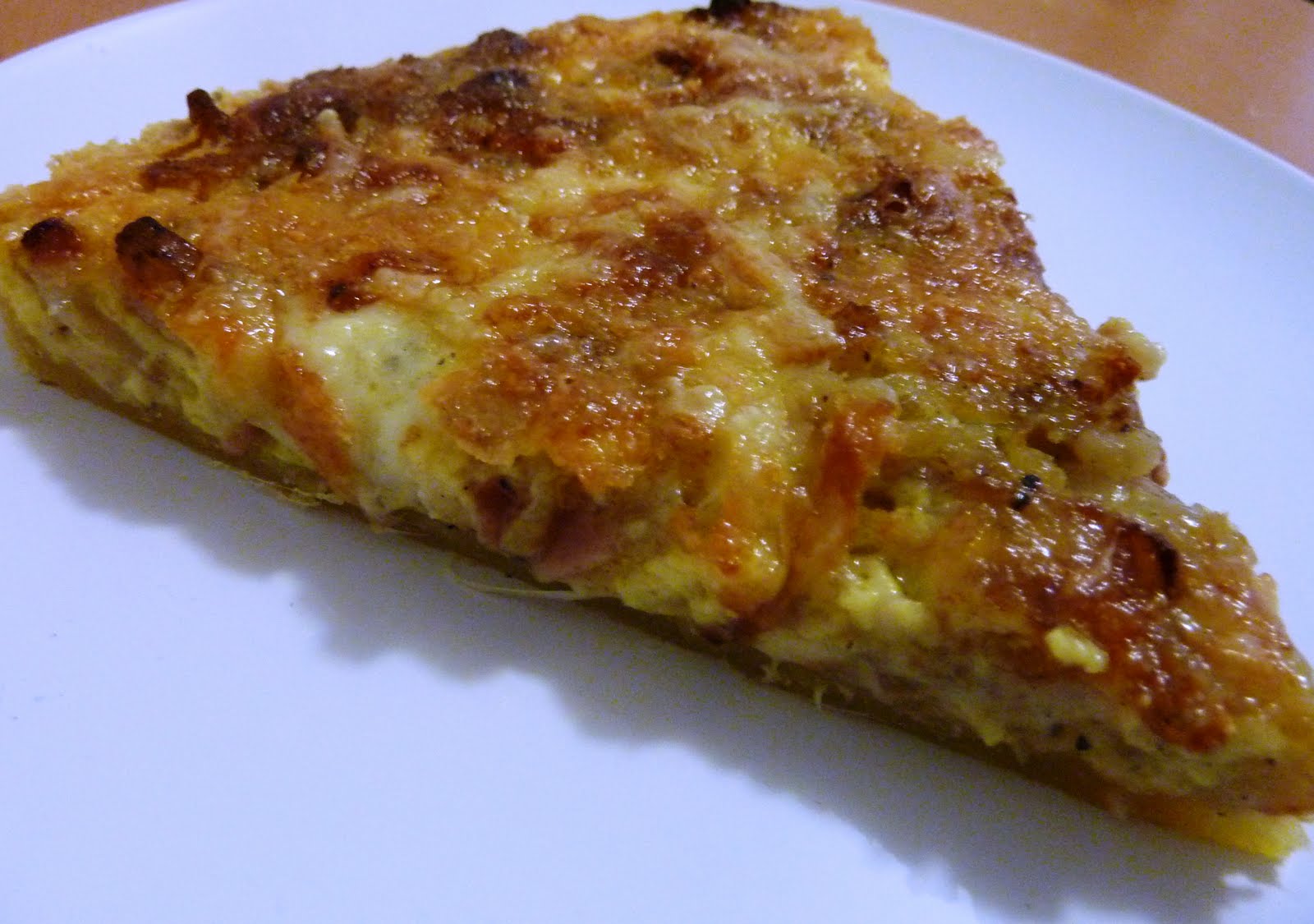
It's funny how inspiration can strike.
Someone had produced a quiche Lorraine on the telly, the prince of quiches, a dish that gets a run around these parts from time to time. What's not to love about the combo of cheese, bacon and sweetly softened onions, a French classic.
It got me thinking though. How would an Italian adapt the recipe to display an altogether different heritage? I'm pretty sure I'll never die wondering about concepts like this.
Replacing the bacon with guanciale, the cured cheek of a pig, seemed logical enough, as did substituting fontina for the gruyere cheese normally used.
But what about the onion, what could you use instead of this kitchen staple, a vegetable that sings out in Italian?

Fennel fitted the bill admirably, behaving similarly to onions by sweetening up as it's cooked down, whilst still retaining its slight aniseed character.


Don't blame me, the aroma wafting from the oven was so divine, I could barely wait for it to cool. In fact, I didn't. Did it have an Italian character? Well, you'll have to make it to really find out, but here's a clue...
Quiche Val d'Aosta
shortcrust pastry, homemade or bought
1 large fennel bulb, trimmed & shredded
1 onion, finely sliced
25g butter
200g guanciale or pancetta, cut into lardons
200g fontina cheese, grated
2 whole eggs
2 egg yolks
300ml double cream
salt & fresh ground pepper
Line a flan ring of about 22cm diameter with the shortcrust pastry. Prick the base all over with a fork, line with foil or baking paper, fill with baking beans and bake in a 200c oven for 10 minutes, then remove the beans and foil and bake for another 10 minutes or until well browned.
Melt the butter in a frying pan and slowly sweat down the fennel and onion with a little salt until completely softened, but not browned. Add the guanciale or pancetta and cook until it just changes colour. Cool.
In a bowl, whisk the whole eggs, yolks and cream until just combined, season well with salt and fresh ground pepper.
Fill the cooked pastry case with this mixture and pour in the whisked cream and eggs. Sprinkle the remaining fontina over the top and bake in a 200c oven for 40 minutes or until well browned. Serve warm or at room temperature.